Building robots that go where the work is

Spinning out our rail robotic arms for manipulation in large workspaces

main

Resume

Apr 2025-Present

Research Fellow, CREATE Lab, EPFL

  • Spinning out our rail-mounted robotic arm system into a startup for dexterous manipulation in large workspaces; first application: sorting surgical tools for sterilization in hospitals.
  • Built a robotics and AI food lab, combining lab automation, food science experiments, and AI-driven optimization. $800k in funding and $100k in deployed pilots.
  • Designed and developed a harvesting robot for hydroponic farming, improving crop management efficiency.
Jan-Nov 2024

Research Fellow, Harvard Microrobotics Laboratory

Extended Project CETI work into a scientific publication on whale-tag suction cup vacuum regeneration.

Oct-Dec 2023

Research Fellow, CREATE Lab, EPFL

Developed a multimodal soft sensor to assess food doneness for robotic cooking applications.

2023

Master's Thesis, Harvard Microrobotics Laboratory

Boston, USA. Project CETI work on vacuum regeneration for whale-tag suction cups to extend attachment time and data collection.

2021-2023

Master's Degree in Mechanical Engineering, EPFL

Design and Production specialization, with research projects at REHAssist Lab and CREATE Lab.

2020-2022

Mechanical Design Internships

3 internships at ECCUS SA., Adonite SA., and Art'Tech SAS. respectively focused on underground storage, metrology tooling, and special machines.

2019-2023

Bachelor's and Master's Degree in General Engineering, Ecole Centrale de Lille

Mechanical Team Leader for Project Voltage, the student electric race car.

Projects

Rail-Mounted Robotic Arms for Large Workspaces

Rail-mounted robotic arms video

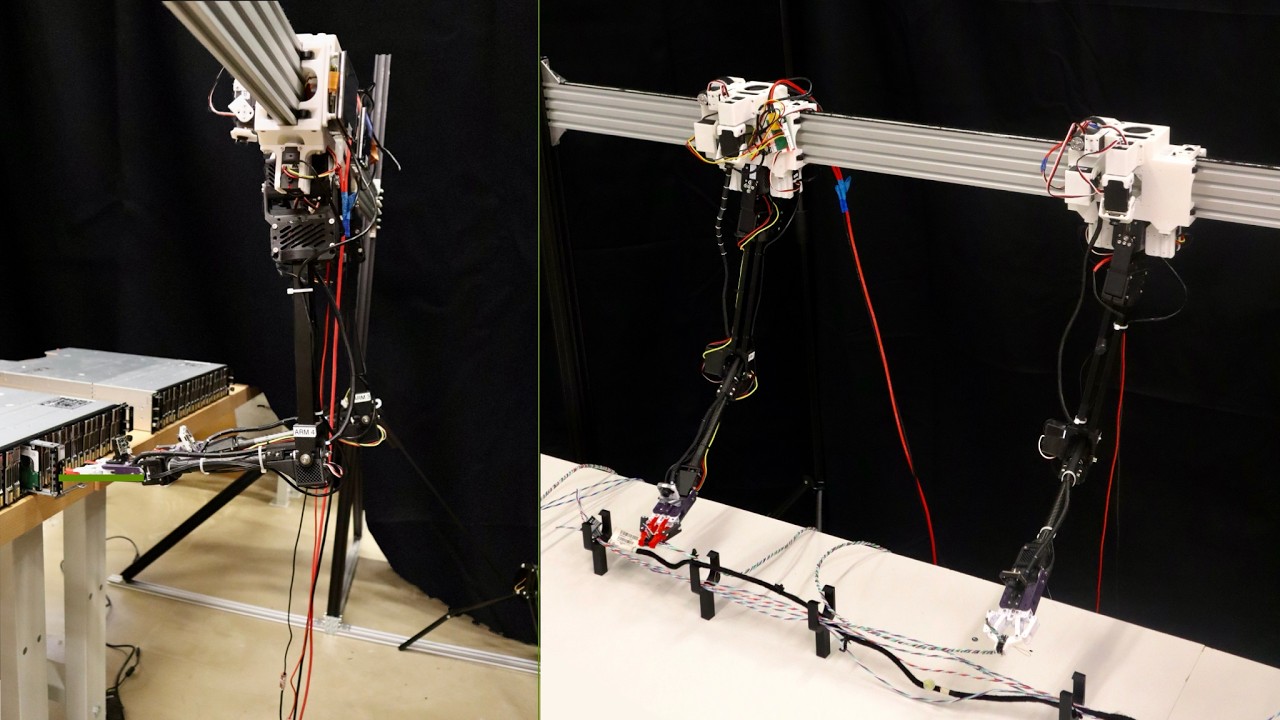
In factories, conveyors move parts to robots. We flip that: our robot goes to parts, working where conveyors can't reach. Spinning out from CREATE Lab at EPFL into a startup, our robots move on a shared rail to cover 100+ m and perform dexterous tasks where needed.

  • Shared robotic workforce: robots are available on demand at each workstation.
  • High throughput: tens of robots work independently or team up for complex tasks.
  • First pilot: sorting surgical tools for sterilization in hospitals.

Robotic and AI Food Lab

Robotic and AI Food Lab video

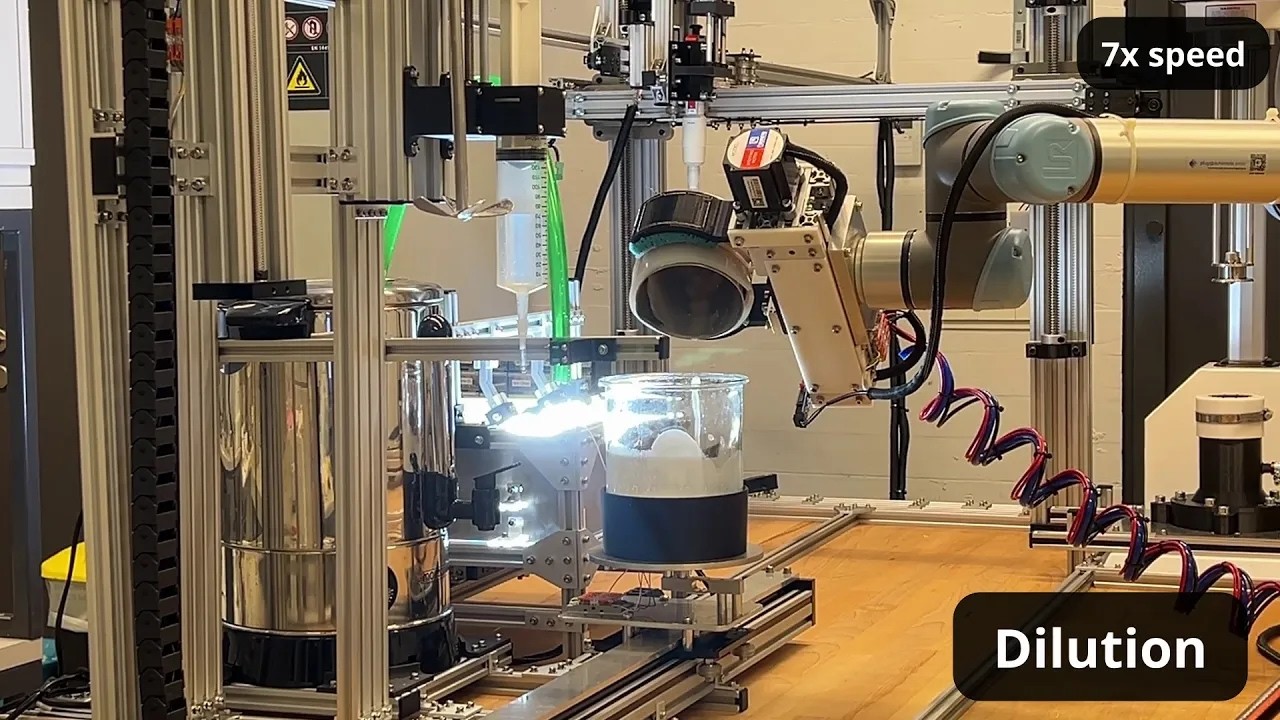
A robotic platform that automates food science experiments, using AI to optimize recipes such as plant-based milks and coffee creamers. The system, built at EPFL in collaboration with Nestlé R&D, handles everything from ingredient dosing to cleaning, and measures viscosity, pH, and stability. Formulations are optimized in as few as 20 trials. $800k in funding and $100k in deployed pilots.

  • Fully automated workflow from ingredient dosing to cleaning and measurements.
  • AI-driven optimization using Bayesian methods for rapid formulation discovery.
  • Combines large-scale robotics, lab automation, and AI-driven experimentation in one platform.

Vertical Farming Robot

Vertical farming robot in a hydroponic environment

A robotic platform for autonomous crop management in vertical hydroponics. It is designed to interact with plants across multiple growth stages, from planting and monitoring to harvesting, in a controlled indoor farming environment.

  • 8-degree-of-freedom robotic base with modular end effectors adapted to different plant stages.
  • Integrated hydroponic system with marker-based plant indexing and computer vision for detection.
  • Achieved precise planting and monitoring, with successful harvesting of different plant types.

Vacuum Regeneration in Whale Tag Suction Cups

Pressure test setup for whale tag suction cup research

Done at Harvard as part of Project CETI, this work extends the attachment time of non-invasive whale tags by using pressure changes during dives to regenerate suction inside the suction cups and preserve data collection for longer deployments.

  • Built a thermodynamic model of the pump and optimized the design with a genetic algorithm.
  • Developed a robust prototype for 800m deep-sea deployments.
  • Achieved vacuum regeneration up to 881% of the starting pressure after five cycles.

First author paper - DOI: 10.1109/JOE.2025.3595607

Multimodal Soft Sensor to Assess Food Doneness

Multimodal food doneness sensor mounted on a robotic arm

A robot fingertip sensor designed to combine tactile, electrical, thermal, vision, and sound information to assess food doneness and help robotic systems make the perfect meal.

  • Combined stiffness, permittivity, conductivity, temperature, vision, and sound in a single fingertip-like package.
  • Designed and fabricated a soft pressure sensor cast in silicone together with the other sensing modalities.
  • Distinguished cooking-time differences on toast samples as small as 30 seconds.

Paper presented at RoboSoft 2024 - DOI: 10.1109/RoboSoft60065.2024.10521945

Intuitive Teleoperation Device for Neuroendovascular Surgery

Intuitive teleoperation device for neuroendovascular surgery

Designed a force-feedback teleoperation for catheter translation and rotation that aims to preserve surgical dexterity while reducing the direct exposure of surgeons to X-ray imaging.

  • Two scroll wheels control catheter translation and rotation with force feedback.
  • Developed the concept through functional decomposition, a morphological matrix, and a decision matrix.
  • Built a working device reaching 100 µm precision with force feedback up to 10 N.

Patent pending EP25181805

Morphogenesis-Inspired Reconfigurable Robots in Aquatic Environments

Aquatic morphogenesis-inspired robot experiment

A system inspired by natural adhesion and de-adhesion phenomena to control the configuration of floating objects in water using stochastic behavior and Markov-chain-based control.

  • Built an experimental setup with a controllable bubble wall and computer vision tracking.
  • Modeled stochastic object interactions through state-transition probabilities and Markov chains.
  • Achieved successful state transitions with experiments following the predicted trend.

Paper presented at RoboSoft 2025 - DOI: 10.1109/RoboSoft63089.2025.11020845

Characterizing and Refining a Novel Metallic FDM Process

Metallic fused deposition modeling printer prototype

Characterization of a lower-cost metal additive manufacturing process based on polymer loaded with metallic particles and later sintered in an oven, focusing on repeatability and mechanical anisotropy.

  • Refined a metallic FDM workflow using particle-loaded polymer followed by oven sintering.
  • Ran tensile tests across layer orientations and tracked layer behavior with computer vision.
  • Identified print-orientation anisotropy together with elongation limits caused by sintering porosity.

Publications

Vacuum regeneration in whale tag suction cups

Germain Meyer, Daniel M. Vogt, Xinyi Yang, Robert J. Wood

IEEE Journal of Oceanic Engineering, 2025 - DOI: 10.1109/JOE.2025.3595607

An open-source bio-logger for studying cetacean behavior and communication

Daniel M. Vogt et al., including Germain Meyer

PLOS ONE, 2025 - DOI: 10.1371/journal.pone.0337093

Morphogenesis-inspired reconfigurable robots in aquatic environments

Nana Obayashi, Germain Meyer, Kai Junge, Josie Hughes

IEEE RoboSoft, 2025 - DOI: 10.1109/RoboSoft63089.2025.11020845

Multimodal soft sensor to assess food doneness

Kai Junge, Germain Meyer, Emily R. Sologuren, Kieran Gilday, Josie Hughes

IEEE RoboSoft, 2024 - DOI: 10.1109/RoboSoft60065.2024.10521945

Patent pending: intuitive teleoperation device for neuroendovascular surgery

European patent application EP25181805

About

Mountain pic

From a BS and MSc in General Engineering at Centrale Lille (France) to a focus on Mechanical Engineering at EPFL (Switzerland) and robotics research at Harvard (US), I'm now back at EPFL, spinning out rail-mounted robotic arms into a startup after building robotics and AI systems for food science.

My love for cooking fuels my passion for running and skiing. When I'm not in the lab, you'll find me in the mountains or anywhere outdoors.